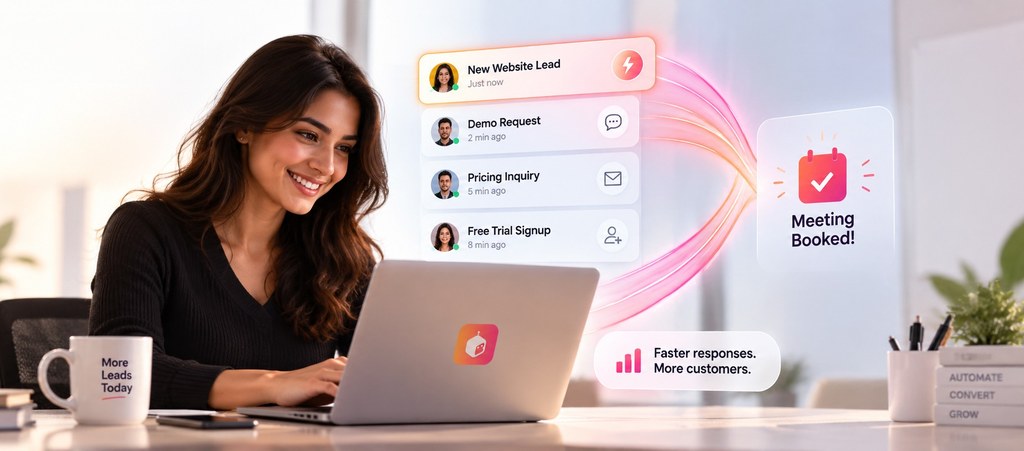
Speed to Lead: Why the First Business to Respond Wins the Customer
In This Document
Never keep a lead waiting. Try AI ChatIQ.
A potential customer lands on your website at 9:47 PM.
They have already spent twenty minutes researching the problem they want solved, opened four different websites, compared a handful of options and finally decided they are interested enough to make an enquiry.
They fill in your contact form.
They click submit.
Then they wait.
Nothing happens.
There is no immediate answer, nobody asks what they need, no appointment is offered and there is no indication of when somebody will get back to them.
So they return to Google.
They open the next website.
This business answers almost immediately, asks two useful questions, explains what happens next and offers an available appointment.
The customer books.
By the time your sales team opens the original enquiry the following morning, the lead still exists inside your CRM, but the buying opportunity may already be gone.
This is the challenge behind speed to lead, and it is one of the reasons businesses can generate significant website traffic without seeing the number of enquiries, appointments and customers they expected.
The problem is not always getting more leads.
Sometimes the bigger problem is what happens immediately after a lead arrives.
Lead response automation helps businesses respond to enquiries immediately, answer common questions, collect useful information, qualify potential customers and guide them toward the next step without waiting for someone on the team to manually notice the enquiry.
For businesses competing for customers who expect quick answers, that first interaction can become one of the most important moments in the entire customer journey.
What Is Speed to Lead?
Speed to lead is the amount of time between a potential customer making an enquiry and receiving the first meaningful response from the business.
The enquiry might come from a website form, landing page, live chat, appointment request, campaign page or another lead-generation channel.
What matters is what happens next.
An immediate response allows the conversation to begin while the visitor is still thinking about the problem they want solved.
A response several hours later reaches the same person in a completely different context. They might be working, travelling, talking to another provider or no longer thinking about the enquiry at all.
That is why businesses should think about lead response time in practical windows.
| Lead Response Time | What May Be Happening |
|---|---|
| Immediate | The customer is still actively engaging with your business |
| Under 5 minutes | Interest and purchase intent may still be very high |
| 5 to 30 minutes | The prospect may begin exploring other options |
| 1 to 2 hours | The customer may already be speaking with competitors |
| Several hours | The original urgency behind the enquiry may have declined |
| Next day | Your team may effectively be trying to reactivate the lead |
There is no universal response time that guarantees a sale because buying behaviour varies by business, product, service and customer.
The principle, however, is much simpler.
Intent is often strongest around the moment someone chooses to contact you.
Your goal should therefore be to make that moment easier to continue.
Why Does Speed to Lead Matter?
Think about the behaviour behind an inbound enquiry.
Someone who requests pricing is not casually browsing anymore.
Someone who starts a conversation about availability has moved beyond awareness.
Someone who asks for a consultation is showing considerably more intent than someone who simply viewed your homepage.
Someone who begins filling in an enquiry form has already taken several steps toward your business.
These moments matter because customer intent is time-sensitive.
Every additional gap between enquiry and response creates another opportunity for something to interrupt the decision.
The prospect may get distracted.
They may forget which website they contacted.
They may discover another business.
They may receive an answer from a competitor.
They may decide the purchase can wait.
They may simply lose the motivation that caused them to enquire in the first place.
This is why instant lead response is not simply a customer-service improvement.
It can directly affect how efficiently marketing turns attention into conversations.
You May Not Need More Leads. You May Need to Stop Losing the Ones You Already Have
Imagine a business spending thousands every month on SEO, Google Ads, social media campaigns, content marketing and landing-page optimisation.
Traffic increases.
Form submissions increase.
The marketing dashboard looks healthy.
Yet revenue remains relatively flat.
The immediate reaction is often to generate even more traffic.
Increase the advertising budget.
Publish more content.
Launch another campaign.
Build another landing page.
But before spending another dollar on acquisition, there is a simpler question worth asking:
What happens during the first few minutes after someone becomes a lead?
If 100 people enquire and a meaningful percentage wait hours for their first response, increasing traffic may simply increase the number of opportunities entering the same inefficient system.
Marketing generated the opportunity.
The website captured the enquiry.
The follow-up process lost momentum.
That is precisely where lead response automation starts becoming commercially important.
What Happens When a Business Responds Too Slowly?
The Customer Keeps Searching
Submitting a form does not necessarily mean a prospect stops evaluating options.
In many categories, customers will contact several businesses before making a decision.
Your website therefore does not operate in isolation.
The moment somebody leaves it, Google, social media, review websites and competing businesses remain only a few clicks away.
Another Business Starts the Conversation First
The first useful response can shape the rest of the buying journey.
If another business answers the prospect’s initial questions, understands their requirements and suggests a clear next step, that company has already reduced several pieces of uncertainty.
Your eventual response has to restart a conversation that somebody else has already moved forward.
Lead Intent Declines
A person researching a service at 10 AM may be highly engaged at that moment.
At 4 PM, they could be in a meeting.
At 8 PM, they may be spending time with family.
The next morning, the purchase may no longer feel urgent.
The lead has not necessarily disappeared, but the context surrounding the lead has changed.
Sales Teams Spend More Time Chasing
Slow lead response often creates additional work.
Instead of speaking with somebody who is actively waiting for an answer, employees start sending messages such as:
“Just following up on your enquiry.”
“Are you still interested?”
“Please let me know a good time to speak.”
“What time can I call you?”
The team is now trying to recreate engagement that already existed when the customer first contacted the business.
Marketing ROI Can Suffer
Every lead has an acquisition cost, even when it comes from organic search.
SEO requires content.
Advertising requires budget.
Social media requires resources.
Events require money.
Landing pages require development.
Brand building requires time.
If leads are generated but not handled effectively, part of that acquisition investment can be wasted after the marketing team has already done its job.
Be the First to Respond, Every Time
Bookzzy AI ChatIQ answers questions and qualifies leads instantly, so no enquiry goes cold while your team is busy
Speed to Lead Is Important, but Speed Alone Is Not Enough
Imagine receiving this response three seconds after submitting an enquiry:
“Thanks. We received your message. Someone will contact you shortly.”
Technically, the business responded instantly.
Practically, the customer is still waiting.
This distinction is important because effective AI lead response is not about sending an automatic acknowledgement as quickly as possible.
A good first response should move the conversation forward.
That means thinking about four dimensions.
Speed
How quickly did the customer receive a response?
Relevance
Did the response actually address why they contacted the business?
Qualification
Did you collect enough information to understand what they need?
Next Action
Did the interaction help the prospect move toward an appointment, consultation, demo, quotation, telephone call or purchase?
The better formula is therefore:
Fast + Relevant + Helpful + Actionable = Better Lead Experience
Automation becomes much more valuable when it improves all four.
How AI Changes the Speed-to-Lead Journey
Traditional lead management often looks something like this:
Customer submits enquiry → Employee receives notification → Employee notices notification → Employee becomes available → Employee reviews enquiry → Employee replies → Customer responds
Every step introduces a possible delay.
Now compare that with an AI-supported workflow:
Customer submits enquiry → AI detects intent → Customer receives an instant response → Questions are answered → Requirements are collected → Lead is qualified → Next action is offered → Relevant information reaches the team
The objective is not to remove employees from the sales process.
The objective is to prevent employees from being the bottleneck that determines whether the first interaction happens in thirty seconds or three hours.
Humans can then focus on the parts of the conversation where human expertise, judgement and relationship building create the most value.
How AI Chatbots Reduce Lead Response Time
Modern AI chat experiences can act as the first response layer between your website visitor and your business.
Instead of asking every visitor to submit information and wait, they can keep the interaction moving.
1. Respond While the Visitor Is Still on the Website
If a prospect asks a question about your services, they can receive an answer while they are still actively browsing.
There is no dependency on whether a salesperson happens to be available at that exact moment.
2. Capture Leads Outside Business Hours
Customers do not only browse websites between 9 AM and 5 PM.
They research after work.
They compare providers late at night.
They make enquiries on weekends.
They look for appointments early in the morning.
AI-powered lead capture means the website does not have to become passive simply because the office is closed.
3. Qualify Enquiries Automatically
Qualification does not need to begin with a salesperson asking the same basic questions repeatedly.
Depending on the business, an AI conversation could collect information such as:
“What service are you interested in?”
“Where are you located?”
“When do you need the service?”
“What problem are you trying to solve?”
“Would you prefer an appointment or a call?”
“What time works best for you?”
When the human team becomes involved, the conversation can begin with much more context.
4. Answer Common Questions Immediately
A large percentage of early-stage enquiries often revolve around predictable information.
Pricing.
Availability.
Services.
Locations.
Business hours.
Process.
Appointment options.
What happens next.
If the customer can receive these answers immediately, the conversation can progress without waiting for repetitive manual responses.
5. Turn Interest Into Action
This is where lead follow-up automation becomes more useful than a simple chatbot.
The objective should not be to keep somebody chatting endlessly.
The objective is to help move them forward.
A strong conversation changes:
“I’m interested.”
into:
“I’ve submitted my requirements.”
or:
“I’ve booked my appointment.”
or:
“I’ve requested my quote.”
or:
“I’ve scheduled a conversation.”
That transition is where website engagement begins creating pipeline.
Lead Response Automation vs Manual Follow-Up
| Capability | Manual Follow-Up | Lead Response Automation |
|---|---|---|
| Initial response | Depends on staff availability | Can happen instantly |
| After-hours engagement | Usually limited | Available continuously |
| Response consistency | Varies by person | Can follow defined workflows |
| Lead qualification | Performed manually | Can begin automatically |
| FAQ handling | Requires employee time | Common questions can be handled automatically |
| Appointment guidance | Staff dependent | Can be integrated into the journey |
| Follow-up reminders | Requires manual tracking | Can be automated |
| Human involvement | Required from the beginning | Introduced when it adds value |
How Lead Response Automation Works
A practical automated lead response workflow can be understood in seven stages.
Step 1: Capture
A prospect arrives through your website, campaign, chatbot, landing page, contact form or another digital source.
Step 2: Identify
The system recognises that a new enquiry or high-intent interaction has occurred.
Step 3: Respond
The customer receives an immediate and relevant response rather than waiting for someone to manually notice the enquiry.
Step 4: Qualify
The conversation or form gathers information that helps the business understand the requirement.
Step 5: Route
The enquiry can be organised or passed to the appropriate person or workflow.
Step 6: Follow Up
Where appropriate, automated lead follow up helps prevent the conversation from disappearing simply because the customer did not respond immediately.
Step 7: Convert
The customer takes the next meaningful action, whether that means booking an appointment, requesting a quote, scheduling a consultation, speaking with sales or completing another conversion goal.
Where Bookzzy Fits Into the Speed-to-Lead Problem
Bookzzy is built around a simple demand-generation reality.
Your website may already be attracting potential customers. The bigger opportunity is turning more of those visitors into conversations and leads.
Instead of treating lead generation as a single form at the bottom of a website, Bookzzy gives businesses multiple ways to engage visitors based on how those visitors actually want to interact.
AI ChatIQ: Your First Conversation Layer
Some visitors do not want to fill in a traditional form before they understand whether your business can help them.
They have questions first.
AI ChatIQ helps businesses engage these visitors through an AI-powered website conversation that can answer questions, collect lead information, qualify enquiries and guide prospects toward the next step.
Instead of:
Visitor arrives → Visitor browses → Visitor leaves
the journey can become:
Visitor arrives → Visitor asks → AI ChatIQ responds → Visitor engages → Information is captured → Next action begins
For businesses thinking about instant lead follow-up, this means your website can start the conversation instead of simply waiting for the visitor to contact your team.
FormIQ: Build Smarter Paths for Structured Enquiries
Other visitors do not want a conversation.
They know what they need and prefer to submit information quickly.
That is where FormIQ becomes useful.
FormIQ allows businesses to create intelligent forms designed around the information they actually need from a prospect, rather than forcing every enquiry through a generic “Name, Email, Message” form.
A potential customer requesting a quotation may require one set of questions.
A consultation request may require another.
A service enquiry may require something completely different.
The goal is to collect enough information to make the next response more relevant without creating unnecessary friction.
Different Visitors Need Different Conversion Paths
| Visitor Behaviour | Bookzzy Experience |
|---|---|
| Wants to ask a question | AI ChatIQ |
| Wants immediate answers | AI ChatIQ |
| Prefers a structured enquiry | FormIQ |
| Needs qualification | AI ChatIQ or FormIQ |
| Wants to share detailed requirements | FormIQ |
| Visits outside business hours | AI ChatIQ |
| Is ready for the next step | Appropriate Bookzzy conversion journey |
Instead of forcing every visitor through one conversion experience, the website can provide multiple paths toward becoming a lead.
What Speed to Lead Looks Like in Real Businesses
The theory becomes much easier to understand when you see what happens in everyday customer journeys.
Dental Clinic
A prospective patient searches for a dental clinic at 8:40 PM.
They ask:
“I need a dental consultation. Do you have appointments this week?”
Without automation, the enquiry could wait until reception opens the next morning.
With an AI-supported experience, the website can immediately acknowledge the request, understand what type of consultation is required, collect details and guide the visitor toward an appointment enquiry.
Home Services Business
A homeowner suddenly discovers that their air conditioner has stopped working.
They search online and contact several businesses.
The provider that responds quickly, understands the location and collects the service requirement has a much better opportunity to continue the conversation while the problem still feels urgent.
Salon
A visitor asks:
“Do you have appointments available Saturday afternoon?”
This is not simply an information request.
It is buying intent.
An immediate answer that guides the visitor toward availability and booking is far more valuable than an automated message saying somebody will respond tomorrow.
Real Estate Business
A prospect enquires about a property.
Instead of waiting for an agent to manually open the notification, an automated first interaction can gather budget, preferred location, property type and timeline.
The agent receives context rather than another anonymous enquiry.
Consultant or Professional Service
A potential customer visits the website after business hours and writes:
“I’d like to discuss whether your service could work for us.”
An AI conversation can collect requirements, understand the nature of the enquiry and guide the visitor toward scheduling a consultation.
By the time the consultant begins work the following morning, the enquiry is no longer simply a name and email address.
It is a structured sales opportunity.
How to Measure Speed-to-Lead Performance
If you want to improve lead response, begin measuring what happens after lead generation.
Average Lead Response Time
How long does it normally take between an enquiry arriving and the customer receiving a meaningful response?
First Response Rate
What percentage of leads receive a response at all?
Contact Rate
How many leads actually engage after the initial enquiry?
Qualification Rate
What percentage of incoming enquiries meet your definition of a useful or qualified lead?
Appointment or Demo Rate
How many enquiries ultimately schedule the next step?
Lead-to-Customer Conversion Rate
What percentage of leads eventually become customers?
After-Hours Lead Rate
How many enquiries arrive when your sales or service team is unavailable?
This final metric can be surprisingly important.
If a meaningful portion of your website activity happens outside office hours, a manual-only lead response process means some of your highest-intent visitors are consistently being asked to wait.
How to Improve Your Speed to Lead
Improving response time does not require replacing your entire sales process overnight.
Start by fixing the moments where valuable enquiries currently wait.
- Set a clear response-time target so the team understands what good performance looks like.
- Automate the first meaningful response instead of relying exclusively on notifications.
- Identify your most common customer questions and make answers available immediately.
- Build qualification questions into the journey so employees receive useful context.
- Connect website forms to your wider lead workflow instead of allowing submissions to disappear into isolated inboxes.
- Offer an obvious next action such as booking, requesting a quote, scheduling a call or starting a consultation.
- Create an after-hours experience for prospects who visit outside normal operating times.
- Identify high-intent actions so urgent opportunities can be prioritised.
- Track lead response time alongside acquisition metrics because generating a lead and successfully engaging one are different things.
- Use automation and human follow-up together so technology improves speed without removing the human expertise customers need later in the buying journey.
Questions? Answered.
Can't find what you're looking for? Our team typically responds within 2 hours on weekdays.
What is speed to lead?
+Speed to lead is the time between a prospect becoming a lead and receiving the first meaningful response from the business. Shorter response times can help businesses engage people while their interest is still active and reduce the opportunity for the prospect to continue searching elsewhere.
Why does response time matter in sales?
+Response time matters because customer intent changes over time. Someone who has just requested pricing, started a chat or submitted an enquiry is actively thinking about their problem, which creates an opportunity to continue the conversation while the requirement is still relevant
How fast should a business respond to a lead?
+There is no single response time that guarantees conversion across every industry, although businesses should generally aim to respond as quickly as they can while still providing a useful and relevant answer. Automation can help reduce unnecessary delays in the first interaction.
What is lead response automation?
+Lead response automation uses software to recognise new enquiries and trigger appropriate actions such as immediate replies, qualification questions, information capture, routing or follow-up. The purpose is to reduce dependency on employees manually monitoring every incoming lead.
How does AI improve lead response time?
+AI can respond to website visitors immediately, answer common questions, understand basic requirements, collect lead information and guide customers toward actions such as requesting quotes, submitting enquiries or booking appointments.
Can AI chatbots respond to leads instantly?
+AI chat experiences can engage visitors immediately when configured correctly, which allows businesses to start conversations without waiting for an employee to become available. Human employees can then become involved when the enquiry requires additional expertise or personal assistance.
What is automated lead follow-up?
+Automated lead follow-up uses predefined workflows or intelligent systems to continue engaging prospects after an initial enquiry. This might include answering questions, prompting the next action, collecting additional information or reminding the customer about an incomplete conversion journey.