What Are the Benefits of Using AI Chatbots for Small Service Businesses?
In This Document
Switch to AI ChatIQ and see the difference.
AI chatbots for small businesses can help answer customer questions 24/7, capture and qualify leads, reduce repetitive customer service work, and guide visitors toward booking appointments. For service businesses in particular, an AI chatbot can turn a website from a static information source into a place where customers can actually start conversations and take action.
Consider a fairly ordinary situation.
It is 10:30 PM.
A potential customer is searching online for a service they need. Perhaps they are looking for a dentist, a consultant, a repair company, a salon, a fitness studio, or someone who can solve an urgent problem at home.
They land on a business website.
They have one simple question before they are willing to book.
The office is closed.
There is a contact form, but filling it out means waiting until tomorrow. There is a phone number, but calling at 10:30 PM is pointless. The answer might be buried somewhere on the website, but the customer does not want to search five different pages.
So they leave.
A few seconds later, they are on another website.
This is the gap that AI chatbots are increasingly designed to solve.
For a small service business, the value of an AI chatbot is not simply that it can “chat.” Its real value comes from what happens next. It can answer a question, understand what the visitor needs, collect relevant details, identify a potential lead, and help move that person toward an appointment or sales conversation.
For small teams where every enquiry matters, that can make the website significantly more useful.
What Are AI Chatbots for Small Businesses?
An AI chatbot for a small business is an AI-powered website assistant that communicates with visitors, answers questions, captures leads, and helps automate routine customer service tasks.
Unlike older rule-based chatbots, where users often had to choose from rigid menu options, an AI chatbot can support more natural conversations.
A visitor might type:
“Are you open on Saturday?”
“How much does a consultation cost?”
“Do you provide this service in my area?”
“Can I book an appointment?”
“Can somebody call me tomorrow?”
Instead of forcing every visitor through the same predefined route, an AI chatbot can respond to the question being asked and guide the conversation from there.
Depending on how the chatbot is configured, it can also collect a visitor’s name, email address, phone number, service requirement, preferred appointment time, or other relevant information.
It can then route the conversation to a human when needed.
That distinction matters.
The goal is not to remove people from customer service. It is to make sure employees do not have to personally handle every simple interaction before a customer can take the next step.
7 Benefits of AI Chatbots for Small Businesses
The biggest AI chatbot benefits become clearer when you look at the everyday problems small service businesses face.
Missed enquiries.
Slow responses.
Repeated questions.
Visitors abandoning forms.
Customers arriving after business hours.
Employees spending time answering the same questions again and again.
A well-designed chatbot can help address each of these situations.
1. Provide 24/7 Customer Support
Customers do not restrict their research to your opening hours.
Someone may look for a dental appointment during their commute home. A homeowner may search for a repair service late at night. A potential client may compare consultants over the weekend.
Your employees cannot realistically remain available at all times.
Your website can.
A chatbot for customer service can provide that first layer of assistance even when the office is closed.
It can answer common questions about services, availability, locations, appointments, policies, and other information that has been connected to the chatbot.
This is particularly useful for businesses that receive enquiries from customers in different locations or time zones.
Imagine two visitors landing on your website at 11 PM.
The first wants to know whether you provide a particular service.
The second wants to schedule an appointment.
Without conversational support, both visitors may have to wait until the following morning.
With an AI chatbot, both can begin their journey immediately.
The business does not need additional night or weekend staff just to answer common website questions.
And the customer does not feel as though they have reached a closed door.
2. Capture More Leads From Website Visitors
Not every website visitor arrives ready to fill out a form.
Some need reassurance first.
Others have one question standing between browsing and buying.
That is why a chatbot for lead generation can become much more than a customer support feature.
Picture a visitor searching for a home service.
They land on the website and ask:
“Do you serve my area?”
The chatbot confirms the service location and asks:
“What type of work do you need?”
The visitor explains the problem.
The chatbot then collects their contact information and preferred time for a follow-up.
The journey becomes:
Website visitor → Conversation → Qualification → Lead capture → Sales follow-up
That flow feels very different from presenting every visitor with the same “Contact Us” button.
Instead of asking someone to make the first big commitment, the business starts with a conversation.
The chatbot can ask relevant qualifying questions, collect contact details, understand the customer’s requirement, and help distinguish a casual enquiry from a high-intent prospect.
The sales team receives more context too.
Instead of simply seeing:
“John submitted a form.”
They may know what John needs, what service he is interested in, and what question brought him to the business in the first place.
That makes the follow-up conversation more informed from the beginning.
3. Respond to Customers Instantly
Speed matters online.
A customer who asks a simple question does not necessarily want to wait several hours for an email reply.
They also may not want to:
- Fill out a long enquiry form
- Search through multiple website pages
- Wait until business hours
- Call someone for basic information
An AI customer service chatbot can remove some of that friction by responding at the moment the question appears.
Suppose a visitor is considering three local service providers.
One website tells them to submit a form.
One asks them to call tomorrow.
The third lets them immediately ask whether the service is available, clarify a question, and start arranging an appointment.
That immediate interaction makes the third website easier to use.
This is one of the most practical benefits of AI chatbots. They help reduce the distance between a customer’s question and the answer they need.
For small businesses, that first response is especially important because there may not always be a dedicated customer service team watching website enquiries throughout the day.
4. Automate Repetitive Customer Questions
Ask anyone working in a service business what customers contact them about and certain questions usually appear repeatedly.
“What are your opening hours?”
“Where are you located?”
“How much does it cost?”
“Do you offer this service?”
“When is your next available appointment?”
“What areas do you cover?”
“Can I cancel or reschedule?”
These are important questions.
But an employee does not necessarily need to manually type the same answer 30 times.
An AI chatbot can handle many of these first-line enquiries automatically.
That allows employees to spend more time on interactions that actually require human attention, such as complex customer requests, sales discussions, unusual service requirements, existing customer issues, and high-value opportunities.
This is an important distinction for small businesses.
AI should not be viewed simply as a replacement for customer service.
It can instead become a filter between routine questions and conversations where human expertise really matters.
Your team handles the exception.
The chatbot handles the repetition.
5. Book More Appointments
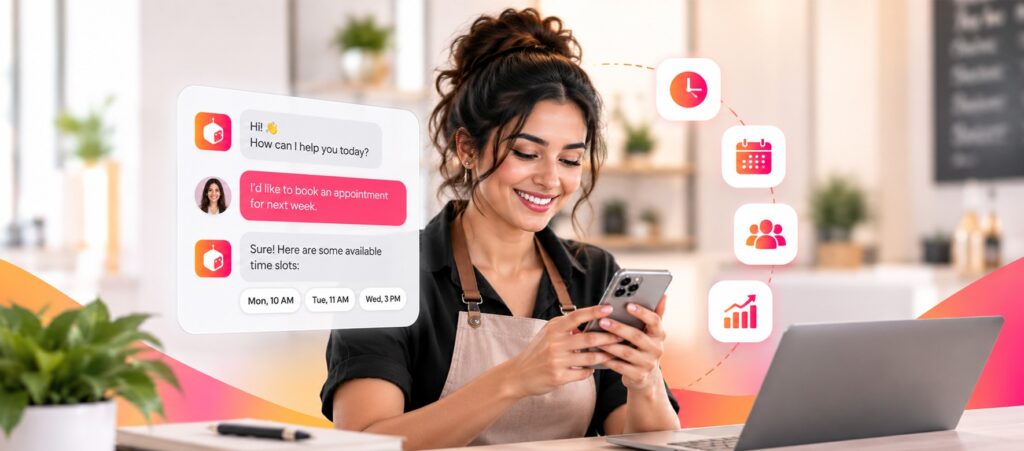
For appointment-based businesses, a conversation becomes much more valuable when it can lead directly to a booking.
Think about how traditional websites often work.
A customer searches for a service.
They visit the website.
They read the page.
They click “Contact.”
They complete a form.
They submit it.
Then they wait.
Every additional step creates another opportunity for the customer to abandon the process.
A conversational booking journey can be much simpler.
A visitor might type:
“I need a consultation.”
The chatbot asks what service they need.
It collects the necessary information.
It guides them toward an available option or time.
Their details are captured.
The appointment process begins.
For salons, clinics, dental practices, home-service companies, consultants, repair services, fitness businesses, and other professional services, this connection between conversation and booking can be particularly useful.
The chatbot is no longer only answering questions.
It is helping the customer move forward.
6. Reduce Customer Service Workload
Small teams have limited time.
If one employee spends a significant part of the day answering routine website questions, that is time they cannot spend elsewhere.
An AI chatbot can absorb many of these repetitive conversations.
The impact is easy to understand.
Instead of employees repeatedly responding to questions about hours, services, locations, availability, and basic policies, the chatbot provides the initial answer.
Staff can focus on:
- Complex customer requests
- Sales conversations
- Existing customers
- High-value leads
- Service delivery
- Cases requiring judgement or personal attention
This can be particularly valuable as enquiry volumes grow.
Without automation, more website traffic can sometimes create more administrative work.
With the right chatbot setup, a business can handle a larger number of routine conversations without asking the team to personally respond to every one.
7. Improve the Customer Experience
A good customer experience often comes down to removing unnecessary effort.
Can the customer get information quickly?
Can they communicate conveniently?
Can they find the right answer without navigating through five pages?
Can they move from interest to action without restarting the journey?
AI chatbots can help by providing faster responses, consistent answers, easier access to information, and a more direct way to interact with the business.
Consider the difference between these two experiences.
Experience A
Search website → Find contact page → Fill form → Submit → Wait
Experience B
Search website → Start chat → Ask question → Get answer → Continue conversation → Book or leave details
The second journey keeps the customer moving.
That does not mean every customer will want to use chat. Some will still prefer email, forms, or phone calls.
The advantage is that the business gives customers another convenient route.
Turn Your Website Into a 24/7 Customer Assistant
Bookzzy AI Chat IQ answers questions and captures leads. Add your 24/7 answering service in minutes.
Why AI Chatbots Are Especially Useful for Appointment-Based Businesses
Many articles about AI chatbots stop at customer service.
For service businesses, that misses an important part of the story.
A visitor asking a question may already be close to becoming a customer.
The chatbot’s job is not simply to answer them. It can help protect that moment of intent.
Capture Enquiries While Customers Are Ready to Book
Customer intent does not always last.
Someone searching for a service today may choose another provider tomorrow.
Someone comparing businesses tonight may make a decision before your team opens in the morning.
An AI chatbot gives the customer a way to act while the need is still fresh.
Even when an appointment cannot immediately be completed, the business can capture the enquiry and the context around it.
Qualify Customers Before the Appointment
A chatbot can also collect useful information before an appointment request reaches the team.
For example:
“What service are you looking for?”
“When would you like to visit?”
“Is this your first appointment?”
“What do you need help with?”
The business begins the human conversation with more context.
For the customer, this can also reduce repetition because they have already explained the basics.
Reduce Missed Opportunities After Business Hours
Return to the customer browsing at 10:30 PM.
They ask a question.
The chatbot responds.
They explain what they need.
Their information is captured.
The appointment process begins.
Even though nobody is sitting behind a desk at that hour, the enquiry has not disappeared.
This is one of the clearest use cases for an AI chatbot for service businesses.
Handle Multiple Customers at Once
A human employee can realistically manage only a limited number of conversations simultaneously.
A chatbot can communicate with multiple website visitors at the same time.
For a business experiencing a surge in website traffic or enquiries, that can prevent simple questions from forming a queue.
Keep Appointment Conversations Simple
Traditional appointment journeys often involve unnecessary movement between pages.
Traditional journey:
Website → Contact page → Form → Submit → Wait for response
Conversational journey:
Website → Chat → Questions answered → Appointment
The fewer unnecessary steps a customer faces, the easier the website becomes to use.
AI Chatbot vs Contact Form vs Live Chat
AI chatbots, traditional contact forms, and live chat all have a place on a business website.
The difference lies in how they handle the conversation.
| Situation | AI Receptionist | Human Receptionist |
|---|---|---|
| Answering frequently asked questions | Well suited | Well suited |
| Responding outside normal business hours | Can remain available | Depends on working hours |
| Handling several digital conversations at once | Can handle simultaneously | Limited by workload |
| Collecting basic enquiry information | Can automate the process | Can collect manually |
| Following a defined qualification flow | Consistent | Depends on training and workload |
| Handling unusual situations | Limited | Much stronger |
A contact form is effective when someone is already prepared to submit an enquiry.
Live chat works well when a team member is available.
An AI chatbot fills a different role. It can respond immediately while reducing the amount of human involvement required for routine conversations.
For many small service businesses, the strongest website experience may involve several options rather than choosing only one.
How Do AI Chatbots Help Small Businesses Generate Leads?
The biggest misconception about chatbots is that they exist only to answer questions.
A well-designed chatbot can also become an interactive lead-capture point.
The journey might look like this:
Website Visitor
↓
Starts Conversation
↓
Asks Question
↓
AI Answers
↓
Qualification Questions
↓
Contact Details
↓
Appointment or Sales Follow-Up
Consider a visitor who asks:
“Do you offer consultations?”
Answering “yes” solves the immediate question.
But stopping there wastes an opportunity.
A more useful conversation might continue with:
“What type of consultation are you looking for?”
“Would you like to speak with someone from the team?”
“Can I get your contact details?”
Now customer service and lead generation are part of the same experience.
That is why businesses evaluating a chatbot should look beyond the number of questions it can answer.
The better question is:
What can the customer do after receiving the answer?
Which Small Businesses Can Benefit From AI Chatbots?
AI chatbots can be useful across many service industries because the same customer journey appears repeatedly: question, qualification, contact information, appointment, follow-up.
Examples include:
- Salons and spas: Answer service questions and help with appointment enquiries.
- Dental clinics: Respond to treatment questions and capture appointment requests.
- Healthcare practices: Handle basic enquiries and guide patients toward the appropriate next step.
- Home-service companies: Understand the customer’s requirement, location, and quote request.
- Real estate agencies: Capture property requirements and buyer or tenant enquiries.
- Legal services: Gather initial enquiry details before a consultation.
- Fitness studios: Answer membership and class questions and capture trial enquiries.
- Consultants: Understand the prospect’s requirements before scheduling a conversation.
- Education and training businesses: Answer course questions and collect prospective student details.
- Repair and maintenance businesses: Capture the issue, location, and service requirement.
- Automotive services: Handle service enquiries and appointment requests.
- Professional services: Qualify prospective clients before passing them to the right person.
The common factor is not the industry.
It is the conversation.
If customers regularly ask questions before booking, enquiring, or buying, an AI chatbot may have a useful role.
What Should a Small Business Look for in an AI Chatbot?
Not every chatbot is equally useful.
Small businesses should evaluate whether the platform supports the customer journey they actually want to create.
Look for:
Easy Website Integration
Adding the chatbot should not require rebuilding the entire website.
AI-Powered Responses
Visitors should be able to ask questions naturally rather than navigating only through predefined buttons.
Lead Capture
The chatbot should be able to collect relevant contact information and requirements.
Appointment Booking
For appointment-based businesses, the conversation should be able to lead naturally toward scheduling.
Human Handoff
Customers should be able to reach a person when the conversation requires human involvement.
Conversation History
Teams should be able to understand what the visitor asked before taking over the conversation.
Customization
The experience should reflect the business, its services, and the information customers actually need.
Analytics
Businesses should be able to understand how visitors are interacting with the chatbot and where conversations may need improvement.
Multilingual Support
Businesses serving customers across different regions may need conversations in more than one language.
Mobile-Friendly Experience
The chatbot should work comfortably for customers visiting the website from their phones.
The goal is not to choose the chatbot with the longest feature list.
It is to choose one that helps customers complete the journeys that matter to the business.
How to Get Started With an AI Chatbot
The best chatbot experiences usually begin with the business process, not the technology
Step 1: Identify Repetitive Customer Questions
Look at emails, enquiry forms, live chat conversations, phone calls, and conversations with customers.
Which questions appear repeatedly?
Start there
Step 2: Define the Chatbot's Role
Decide what you actually want it to accomplish.
Should it answer FAQs?
Generate leads?
Qualify customers?
Support appointment booking?
Hand visitors to live agents?
The answer may include several of these, but the role should be clear.
Step 3: Connect Important Business Information
Give the chatbot access to the information it needs to answer common customer questions accurately.
That may include services, opening hours, locations, availability, policies, and other frequently requested information.
Step 4: Create Lead and Appointment Flows
Do not stop at answering questions.
Think about the next action.
If a visitor shows interest, what information should the chatbot collect?
If they want an appointment, where should the conversation lead?
If they need a person, how should the handoff happen?
Step 5: Review Conversations and Improve
Customer questions will show you what the chatbot needs to do better.
Review conversations regularly.
Look for unanswered questions, confusing responses, repeated requests, and moments where visitors leave.
Then improve the experience.
A chatbot should evolve with the business.
Turn Your Website Into a 24/7 Customer Assistant With Bookzzy
Your website may already be attracting potential customers.
The bigger question is what happens when they arrive.
With Bookzzy’s AI Chat IQ, businesses can engage website visitors, answer questions, capture leads, and help customers take the next step through a conversational experience.
Instead of asking every visitor to search, submit, and wait, you can give them a way to start the conversation immediately.
Build Your AI Chatbot with Bookzzy.
Final Thoughts
For a small service business, losing a website visitor rarely looks dramatic.
There is no alarm when somebody arrives at 10:30 PM, cannot get an answer, and leaves.
There is no notification when a customer decides a contact form feels like too much effort.
There is no report showing exactly how many people considered booking but wanted one question answered first.
They simply disappear.
That is why the real value of AI chatbots for small businesses is not the novelty of having AI on a website.
It is availability.
It is reducing friction between a question and an answer.
It is turning anonymous website traffic into conversations.
It is helping a potential customer move from “I am interested” to “Here is what I need.”
And for appointment-based service businesses, it is about being present at the exact moment when someone is ready to take the next step, even when nobody from the team happens to be online.
A good chatbot should not make the business feel less human.
It should make it easier for the human conversation to begin.
Questions? Answered.
Can't find what you're looking for? Our team typically responds within 2 hours on weekdays.
What are the benefits of AI chatbots for small businesses?
+AI chatbots can help small businesses provide 24/7 customer support, answer repetitive questions, respond instantly, capture and qualify leads, support appointment booking, and reduce routine customer service work. They can be particularly useful for businesses where customers frequently ask questions before making an enquiry or booking a service.
Are AI chatbots worth it for small businesses?
+AI chatbots can be worthwhile for small businesses that receive regular website enquiries, appointment requests, repetitive questions, or customer interactions outside normal business hours. Their value depends on whether the chatbot solves a genuine customer service, lead generation, or booking problem for the business.
How do chatbots help with lead generation?
+A chatbot can engage website visitors, answer their questions, ask qualifying questions, collect contact details, understand their requirements, and pass relevant information to the sales team. This turns the chatbot into an interactive lead-capture channel rather than simply a customer support tool.
Can an AI chatbot book appointments?
+An AI chatbot can support appointment-based customer journeys by understanding what service a customer needs, asking relevant questions, collecting their details, and guiding them toward an available appointment option or booking process.
Can small businesses use AI chatbots for customer service?
+Yes. Small businesses can use AI chatbots to handle routine customer service questions about opening hours, services, locations, availability, appointments, policies, and other common topics. More complex conversations can still be handed over to a human employee.
Do AI chatbots work outside business hours?
+Yes. One of the primary benefits of AI chatbots is that they can remain available when employees are offline. Customers can ask questions, provide their details, and begin an enquiry or appointment journey even during evenings, weekends, or other times when the business is closed.
Can AI chatbots replace human customer service?
+AI chatbots are better suited to automating routine interactions than replacing human customer service entirely. They can answer repetitive questions, collect information, and manage the first stage of an enquiry. Human employees remain important for complex requests, sensitive conversations, sales discussions, and situations requiring judgement or personal attention.