AI Scheduling Assistant vs. Chatbot: What’s the Difference and Which Do You Need?
In This Document
Never keep a lead waiting. Try AI ChatIQ.
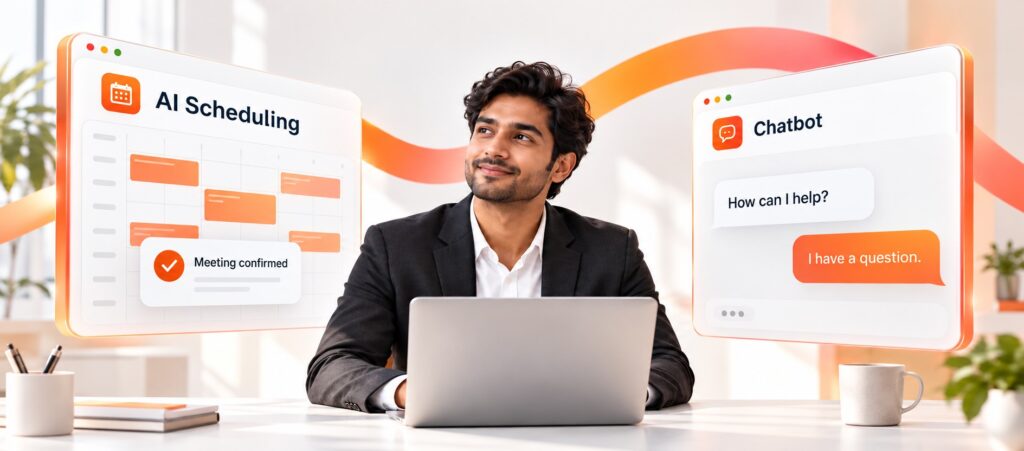
An AI scheduling assistant is software that helps customers book, reschedule, and manage appointments by working with available time slots and scheduling rules, while a chatbot is a conversational tool designed to answer questions, engage website visitors, collect information, and capture leads.
Although these two technologies are often discussed together, they solve very different problems within the customer journey, and businesses sometimes purchase one expecting it to perform the role of the other. A company may install a chatbot hoping that it will automatically manage appointments, while another business may add a scheduling tool and later discover that visitors still need answers before they feel confident enough to choose an appointment.
The distinction becomes much easier to understand when you look at the visitor’s intention at the moment they arrive on your website. Someone who already knows exactly what they want may simply need a convenient way to choose an available time, while another visitor may need to understand your pricing, services, availability, or suitability before they are willing to book anything.
For many businesses, this means the real decision is not simply whether to choose an AI scheduling assistant or a chatbot. The more useful question is how conversation, lead capture, and booking can work together without creating unnecessary friction for the visitor.
This guide compares both technologies, explains where each performs best, and shows how businesses can create a more connected path from website visit to genuine sales opportunity.
Quick Answer: AI Scheduling Assistant vs. Chatbot
An AI scheduling assistant and a chatbot both help businesses interact with website visitors, but they serve different purposes within the conversion journey.
An AI scheduling assistant is primarily designed to help people choose and confirm appointments, which makes it particularly useful when visitors already have strong intent and simply need a convenient way to secure a suitable time.
A chatbot, by comparison, focuses on communication by answering common questions, helping visitors understand products or services, capturing contact information, and guiding potential customers towards the next appropriate step.
The most important difference is therefore not whether one technology is more advanced than the other, but whether your visitor currently needs information or action.
If most website enquiries already end in appointments, scheduling automation may be the immediate priority. If visitors frequently ask questions before they are ready to commit, conversational engagement may have a greater impact on lead generation.
However, businesses often encounter both types of visitors, which is why connecting conversation with scheduling can create a considerably stronger website conversion experience.
Be the First to Respond, Every Time
Bookzzy AI ChatIQ answers questions and qualifies leads instantly, so no enquiry goes cold while your team is busy
What Is an AI Scheduling Assistant?
An AI scheduling assistant is software that helps automate the process of arranging appointments by allowing visitors to select available dates and times without relying on a member of staff to coordinate every booking manually.
AI appointment scheduling is particularly useful for businesses where consultations, meetings, demonstrations, treatments, interviews, or service appointments are an important part of the sales or customer journey.
Traditional appointment coordination can involve several interactions before anything is confirmed. A prospect sends an enquiry, an employee replies with several available times, the prospect responds with another preference, the employee checks the calendar again, and the process continues until both sides eventually agree on a suitable slot.
Although each individual message may only take a few minutes, the administrative cost becomes significant when the same process happens repeatedly across dozens or hundreds of enquiries.
An AI scheduling assistant can simplify this journey by allowing visitors to view appropriate availability and choose a suitable time without waiting for someone to respond manually.
How AI Scheduling Works
The exact workflow varies between scheduling platforms, but the overall journey usually follows four stages.
1. A visitor decides that they want an appointment
The visitor may be looking to schedule a consultation, product demonstration, dental appointment, interview, salon service, discovery call, or another type of time-based interaction.
2. The scheduling system checks available options
The platform uses configured working hours, services, calendar availability, and booking rules to determine which time slots can be offered to the visitor.
3. The visitor chooses a suitable time
Instead of exchanging several emails or messages with a member of staff, the customer selects from the available options and provides the required booking information.
4. The booking moves into the business workflow
Once the appointment is confirmed, the scheduling process can continue according to the capabilities and integrations of the tool being used.
The practical advantage is not simply automation for the sake of automation. It is the reduction of friction at a point when the visitor has already shown meaningful intent.
When somebody is ready to speak with your company, requiring them to wait for a manual response can introduce an unnecessary reason to abandon the process.
What Is an AI Scheduling Assistant Good At?
AI scheduling tools are particularly useful when businesses experience high volumes of appointment-related enquiries or when staff regularly spend time coordinating availability.
For example, a clinic may receive appointment requests throughout the day, while a SaaS company may need prospects to schedule product demonstrations with its sales team. A consultant may receive enquiries from several time zones, while a recruitment company may coordinate interviews between candidates and hiring managers.
In each of these situations, the scheduling challenge is similar. The customer has already demonstrated interest, but both sides still need to find a suitable time.
An AI scheduling assistant can help by giving visitors access to available booking options at any time, reducing repeated communication around availability, supporting a more consistent booking process, and making it easier to handle growing appointment volumes without adding the same amount of administrative work.
The customer experience can also improve because the visitor does not need to wait for the business to open before making progress.
A prospective customer researching services late in the evening may prefer to secure an appointment immediately rather than make a mental note to contact the company again the next morning.
That convenience can matter more than businesses sometimes realise.
Where an AI Scheduling Assistant Can Fall Short
Scheduling technology works particularly well when the visitor already knows what they want, but that is not how every customer behaves.
Many website visitors arrive with questions that need to be answered before they are willing to make an appointment.
A potential dental patient may want to understand the difference between two treatments before choosing a consultation. A software buyer may need to know whether the platform integrates with existing systems before booking a demonstration. A salon customer may need to confirm whether a particular treatment is suitable for their hair type before choosing a service.
In these situations, presenting a booking calendar too early may not move the visitor any closer to conversion because availability is not yet their main concern.
Their concern is confidence.
They want to know whether your business can solve their problem, whether the service is suitable for them, and whether taking the next step is worthwhile.
This is where a chatbot can play a very different role.
What Is a Chatbot?
A chatbot is a conversational interface that communicates with visitors through a website or another digital channel.
Some chatbots follow predefined rules and conversation flows, while AI-powered chatbots can understand a broader range of visitor questions and respond using information available to the system.
Regardless of the underlying technology, the primary purpose of a chatbot is conversation rather than scheduling.
A chatbot can answer commonly asked questions, help visitors understand available services, collect lead details, identify what the visitor is interested in, and guide them towards an appropriate next action.
For businesses that receive website traffic outside normal working hours, this can create an important additional opportunity to engage visitors when their interest is at its highest.
A person researching a product at 10:30 PM may have several questions before they are ready to submit an enquiry. If the website offers no useful interaction at that moment, the visitor may simply continue researching competitors.
A conversational experience gives the business another opportunity to keep the customer engaged.
What Is a Chatbot Good At?
Chatbots are particularly useful when visitors need information before they are prepared to commit.
A prospective customer may want to ask whether a service is available in their location, whether pricing begins at a certain level, how implementation works, whether a product supports a particular use case, or which service is most appropriate for their requirements.
These questions often appear simple, but they can strongly influence whether the visitor continues with your business.
A chatbot can also support lead capture by collecting relevant contact information during the conversation.
Instead of showing every visitor the same static form with fields such as name, email, phone number, company, and message, a conversational experience can collect information in a context that feels connected to what the visitor is already trying to accomplish.
For example, a visitor asking about a particular service may be more willing to provide their email address after receiving a useful answer than they would be if they were immediately presented with a long contact form.
The difference lies in timing.
A good conversion experience asks for information when the visitor can understand why providing it is useful.
Where Chatbots Can Fall Short
The biggest weakness of a chatbot often appears when the visitor has finished asking questions and is ready to take action.
Imagine that someone spends several minutes discussing your service with a chatbot, receives the answers they need, becomes interested, and then asks to book a consultation.
If the chatbot simply responds with a link saying “Book here,” the visitor is effectively being asked to start another journey.
They may be sent to another page where they need to choose a service again, enter information they have already provided, select a date, and complete another set of fields.
From the company’s perspective, these may be separate systems performing separate jobs.
From the customer’s perspective, they were already speaking with the same business.
This disconnect is one reason why businesses should think carefully about how conversational experiences connect with booking workflows.
AI Scheduling Assistant vs. Chatbot: Side-by-Side Comparison
| Factor | AI Scheduling Assistant | Chatbot |
|---|---|---|
| Primary purpose | Helps visitors book and manage appointments | Helps visitors ask questions and interact with the business |
| Main conversion role | Turns booking intent into a scheduled appointment | Turns website interest into conversation and captured leads |
| Booking capability | Appointment scheduling is the core function | Often guides the visitor towards a separate booking process |
| Lead capture | Collects information required for the appointment | Can capture and qualify lead information during conversations |
| Pre-booking questions | Usually limited compared with conversational tools | One of the primary use cases |
| Best suited for | Businesses where enquiries frequently become appointments | Businesses where customers need information before converting |
| Setup focus | Calendar availability, services, schedules, and booking rules | FAQs, knowledge, conversation flows, and lead questions |
| Main risk when used alone | Visitors may still need answers before they book | Visitors may receive answers but never complete a booking |
The difference becomes much easier to see when both tools are considered within the same customer journey.
A scheduling assistant is strongest when intent is already high, while a chatbot is strongest when the visitor is still building confidence.
When Do You Need an AI Scheduling Assistant?
An AI scheduling assistant becomes particularly valuable when appointments are a regular and important part of your customer journey.
Your Team Spends Too Much Time Arranging Appointments
If employees regularly exchange several messages simply to find a suitable time for a meeting, consultation, interview, or service appointment, scheduling automation can remove repetitive administrative work.
The objective is not to remove human interaction where it adds value. The objective is to remove human involvement from tasks that do not require human judgement.
Finding an available time is usually one of those tasks.
Customers Try to Book Outside Normal Working Hours
Website visitors do not operate according to your office hours.
Someone may research a dentist after dinner, compare SaaS vendors late at night, search for a consultant over the weekend, or remember that they need an appointment while your team is unavailable.
If the only booking option is to submit a message and wait for someone to respond, the visitor’s momentum is interrupted.
A scheduling experience can allow that customer to continue while their interest is still active.
Most Enquiries Eventually Lead to a Meeting or Appointment
If the most common response from your team is “Let’s schedule a call,” then scheduling should probably be integrated more closely into the website journey.
The customer should not need to wait for your team to provide a scheduling link every time.
You Are Managing Growing Booking Volumes
Processes that work reasonably well at twenty appointments per month can become frustrating at two hundred appointments per month.
As booking volume grows, manual coordination becomes harder to manage consistently.
Automation gives businesses a more repeatable process.
Your Website Generates Interest but Not Enough Bookings
If analytics show that visitors reach your service, contact, or booking pages but frequently leave without completing the next step, the issue may not necessarily be a lack of demand.
The problem may simply be that the conversion journey contains too many steps.
If your website already generates interest, do not make your visitors work unnecessarily hard to become appointments. Start your 14-day Bookzzy free trial and see how BookingIQ can support a simpler booking experience.
When Do You Need a Chatbot?
A chatbot is usually more useful when the main obstacle to conversion is not scheduling but uncertainty.
Visitors Regularly Ask Similar Questions
If your sales, customer support, reception, or service team repeatedly answers the same questions, your website may be missing an opportunity to provide those answers earlier.
Customers often want to understand pricing, availability, features, suitability, location, timelines, or next steps before they are ready to contact someone.
A conversational experience can make this information more accessible.
Your Product or Service Requires Explanation
Some purchases require very little education, while others naturally involve questions.
A B2B software buyer may need to understand integrations, implementation, data handling, or pricing before agreeing to a demonstration.
A patient may need to know which type of consultation to choose.
A customer researching a professional service may need to understand whether the company handles their particular situation.
In these cases, immediately presenting a booking calendar can be premature.
The customer needs answers before availability.
You Want to Capture More Than Basic Contact Information
Static contact forms are useful, but they often provide limited context.
A name and email address do not necessarily tell your sales team what the customer needs or how close they are to making a decision.
Conversational lead capture can provide more context because information is collected as part of the interaction.
Your Business Has Consultative or B2B Sales
B2B buyers rarely arrive on a website knowing that they are ready to speak with sales immediately.
They may spend time comparing products, reading case studies, understanding features, researching competitors, and evaluating whether the solution appears suitable.
A chatbot can help answer some of those questions and capture the visitor when interest becomes stronger.
Your Website Gets Traffic but Too Few Visitors Take Action
Traffic is useful only when it contributes to a meaningful business outcome.
If visitors arrive, browse several pages, and leave without completing a form, starting a trial, or scheduling a conversation, the website may not be giving them the right opportunity to engage.
A chatbot can create another conversion path by allowing the visitor to ask a question instead of requiring them to make an immediate commitment.
With Bookzzy AI ChatIQ, businesses can create a conversational layer for website visitors while capturing leads when interest is active. Start your 14-day free trial and explore how a more interactive website experience can support lead generation.
Why Conversation and Scheduling Should Not Feel Like Separate Journeys
Many websites use a surprisingly fragmented conversion process.
A visitor arrives on the homepage, reads several pages, opens a chatbot, asks a question, receives a link to a contact page, fills in a form, waits for an email, receives a scheduling link, opens another page, chooses an available slot, and finally confirms the appointment.
Every individual step may appear logical when viewed from the perspective of the company’s technology stack.
The customer sees something very different.
They see one company asking them to complete several disconnected tasks.
Each handoff creates another opportunity for the visitor to become distracted, change their mind, open a competitor’s website, or decide to return later and never come back.
A better conversion journey maintains continuity.
A visitor who begins with a question should be able to move naturally towards becoming a lead, and a qualified lead who is ready for a conversation should have a clear path towards scheduling that interaction.
The stages should support one another rather than compete for attention.
Can One Platform Support Both Conversation and Scheduling?
This is where the Bookzzy approach becomes relevant.
Instead of treating website conversion as a single form or isolated widget, Bookzzy is designed around different stages of visitor intent.
AI ChatIQ supports the conversational stage by helping website visitors ask questions and share information.
BookingIQ supports the scheduling stage by helping visitors move towards an appointment.
These tools should be understood as complementary parts of the website conversion journey rather than interchangeable features.
Consider a prospective customer visiting a salon website.
The visitor may begin by asking whether the salon offers balayage, how long the service usually takes, or whether a consultation is recommended first.
At this point, immediately showing a booking calendar does not necessarily solve the visitor’s problem because the visitor is still deciding what they need.
Once those questions have been answered and the customer decides to proceed, scheduling becomes relevant.
A similar journey can happen across several industries.
A patient may ask about treatment options before booking a consultation.
A software buyer may ask whether a platform supports a particular requirement before arranging a demonstration.
A consultant’s prospect may describe their challenge before deciding whether they need a call.
The important principle is that the website experience should support the visitor as their intent changes.
Why Connected Conversion Journeys Matter
Every additional handoff introduces risk.
A visitor may close the browser tab.
They may become distracted by another task.
They may decide to compare another provider.
They may abandon a long form.
They may not want to enter the same information again.
They may decide that contacting your business requires too much effort.
Businesses often spend considerable money generating traffic while paying much less attention to what happens after that traffic reaches the website.
Connecting the conversation and booking stages helps address that problem.
Your Website Is Already Open Around the Clock
The website can continue receiving visitors even when your team is unavailable, which means it should do more than simply display information.
Bookzzy is designed to help businesses make better use of the traffic they already generate by creating more opportunities for visitors to interact, share their details, and move towards the next logical action.
Start your 14-day Bookzzy free trial and explore how AI ChatIQ and BookingIQ can help you create a more connected website conversion journey. No credit card required.
How to Choose Between an AI Scheduling Assistant and a Chatbot
If you are still deciding where to begin, the following questions can help identify which capability addresses the bigger problem on your website.
1. What Percentage of Enquiries Should Eventually Become Appointments?
If almost every serious enquiry should result in a consultation, demonstration, treatment, interview, or meeting, scheduling automation is likely to have a direct impact.
If many visitors are still researching or comparing options when they arrive, conversation may need to happen before scheduling.
2. Do Visitors Need Answers Before They Feel Ready to Book?
Look at the questions currently handled by your sales, support, reception, or customer service teams.
If customers consistently require clarification before taking the next step, the problem is not simply booking availability.
The website needs to help build confidence first.
3. How Many Separate Tools Are You Willing to Manage?
Businesses often add website tools one problem at a time.
One tool handles chat.
Another handles contact forms.
Another handles scheduling.
Another handles exit intent.
Another collects leads.
Over time, the website can become a collection of disconnected conversion technologies.
Each additional tool may introduce another subscription, integration, login, script, dashboard, and source of customer data.
Evaluating the entire conversion journey can therefore be more useful than choosing tools based only on isolated feature lists.
4. Does the Scheduling Workflow Fit the Way Your Business Operates?
Scheduling software should fit around your actual availability, services, calendar structure, and appointment rules.
A tool that saves the customer time but creates more work for your internal team is not solving the full problem.
Before selecting any solution, confirm the capabilities that matter to your workflow.
5. What Happens When a Visitor Is Interested but Not Ready to Book?
This may be the most important question of all.
Not every valuable visitor is ready to schedule immediately.
Someone may genuinely be interested in your company while still needing more information.
If the website only provides a “Book now” button, those visitors may leave without giving you any way to continue the relationship.
A conversational lead capture experience gives them another path.
They can ask a question, share their details, and potentially become a sales opportunity even if they do not schedule an appointment during the first visit.
The Best Conversion Experiences Match Visitor Intent
One of the biggest mistakes businesses make is assuming that every visitor should follow the same journey.
Website visitors arrive with very different levels of awareness and intent.
One person may be researching a problem for the first time.
Another may already be comparing several vendors.
Another may have read multiple pages and simply needs one question answered.
Another may already know that they want an appointment and only needs to choose a time.
A website that forces all four visitors into the same conversion path is unlikely to serve any of them particularly well.
Instead, businesses should provide multiple ways to move forward.
Visitors who need information should be able to ask questions.
Visitors who are interested should be able to share their details without unnecessary friction.
Visitors who are ready to speak with the business should be able to move towards scheduling.
Visitors who are about to leave may benefit from another relevant opportunity to engage.
This broader conversion philosophy is where Bookzzy’s suite approach becomes useful.
Bookzzy includes AI ChatIQ for conversational engagement, BookingIQ for scheduling, FormIQ for lead capture, and RetainIQ for retention-focused website experiences.
Rather than forcing every visitor through one fixed funnel, businesses can create several opportunities to capture intent at different moments.
AI Scheduling Assistant vs. Chatbot for Small Businesses
Small businesses often assume that automation becomes useful only after a company reaches a certain size, but the opposite can be true.
A small business usually has fewer people available to respond to enquiries, manage appointments, answer repetitive questions, and follow up with website leads.
This means every interruption has a greater operational cost.
If a team member needs to stop working several times each day simply to answer questions about availability or coordinate appointments, even modest automation can save meaningful time.
The important consideration is not business size but process volume.
A three-person dental clinic with hundreds of monthly appointments may benefit from scheduling automation more than a fifty-person company where customers rarely book meetings.
Similarly, a small professional services company that receives the same twenty pre-sales questions every week may gain significant value from conversational automation.
The right question is therefore not whether your company is large enough to use these tools.
The right question is whether repetitive website interactions are consuming time or causing potential customers to disappear.
AI Appointment Scheduling and Lead Generation Should Support Each Other
Scheduling is often treated as an administrative function, while lead generation is treated as a marketing function.
From the customer’s perspective, however, the two activities can be closely connected.
A visitor may begin as anonymous traffic, ask a question, share an email address, become a qualified lead, and book an appointment during the same website session.
If marketing, lead capture, and scheduling systems do not communicate effectively, valuable context can disappear between those stages.
This is why modern website conversion strategy should look beyond individual widgets.
The goal is not simply to install a chatbot.
The goal is not simply to install a scheduling assistant.
The goal is to reduce the distance between visitor interest and meaningful action.
For one visitor, meaningful action might be asking a question.
For another, it might be sharing contact details.
For another, it might be scheduling a consultation.
Your website should make each of those actions easy.
Conclusion: Talk First, Book Next, or Support Both?
Choosing between an AI scheduling assistant and a chatbot becomes much easier when you stop comparing feature lists and start thinking about what your website visitors are actually trying to accomplish.
If your customers already know what they need and primarily want a convenient way to choose a suitable appointment time, an AI scheduling assistant can remove unnecessary coordination and create a smoother path towards booking.
If visitors frequently need answers, guidance, reassurance, or more information before they feel comfortable taking the next step, a chatbot can help keep them engaged while their interest is still active.
For many businesses, however, the strongest experience is not choosing one capability and ignoring the other.
Real customers move between research, conversation, lead capture, and booking naturally, sometimes within the same website visit.
Your conversion journey should be able to move with them.
Bookzzy is designed around that broader website conversion challenge by helping businesses create more opportunities for visitors to engage through tools such as AI ChatIQ, BookingIQ, FormIQ, and RetainIQ.
Your website may already be attracting traffic through SEO, social media, referrals, advertising, or content marketing.
The opportunity is to make more of those visits count.
Start your 14-day Bookzzy free trial today and explore how a more connected approach to conversation, lead capture, and scheduling can help turn website traffic into real opportunities. No credit card required.
Questions? Answered.
Can't find what you're looking for? Our team typically responds within 2 hours on weekdays.
What is AI scheduling?
+AI scheduling refers to software that helps automate appointment-related tasks by using configured availability, scheduling rules, services, and calendar information to help visitors find suitable appointment times. It is commonly used to reduce repetitive manual coordination while giving customers a more convenient way to schedule meetings or services.
What is the difference between an AI scheduling assistant and a chatbot?
+An AI scheduling assistant primarily helps visitors schedule and manage appointments, while a chatbot primarily handles conversations by answering questions, collecting information, and engaging potential customers. Scheduling tools are most useful when the visitor is ready to take action, while chatbots are more useful when the visitor still needs information.
How does AI lead capture integrate with scheduling?
+AI lead capture can collect visitor information and understand what the person is interested in before scheduling becomes relevant. Once the visitor has enough information and wants to continue, the scheduling stage can provide a clear route towards selecting an appointment.
Can a chatbot book appointments?
+Some chatbot platforms connect directly with scheduling tools, while others send visitors to a separate booking experience. Businesses should confirm the exact workflow and integrations of the product they are evaluating rather than assuming that every chatbot includes complete appointment booking functionality.
Is an AI scheduling assistant worth it for a small business?
+An AI scheduling assistant can be valuable for a small business when appointment coordination takes significant staff time, customers regularly try to book outside business hours, or the business manages enough appointments that manual scheduling creates unnecessary delays.
Do AI scheduling assistants work with Google Calendar and Outlook?
+Many scheduling platforms provide integrations with popular calendar products such as Google Calendar and Outlook, although the exact integrations vary between providers. Businesses should verify supported calendar connections and workflow requirements before selecting a platform.
Is a chatbot better than a contact form?
+A chatbot and a contact form solve slightly different problems. A traditional form works well when visitors already understand what they need to submit, while a chatbot can be more effective when people still have questions or require guidance before they are willing to provide their details.