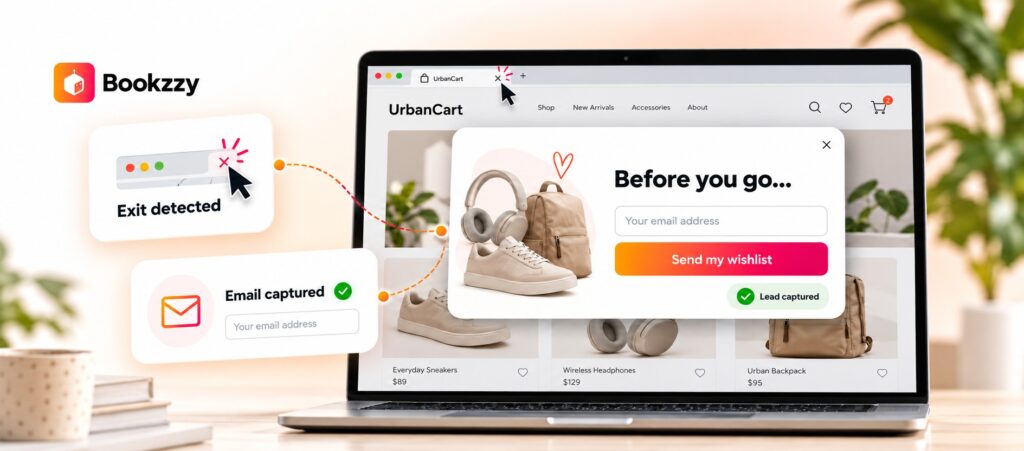
Stop Losing Ecommerce Visitors: How to Capture Leads Before They Leave Your Website
In This Document
Never keep a lead waiting. Try AI ChatIQ.
Getting people to visit your ecommerce website is only the beginning. The bigger challenge is turning that traffic into something your business can continue working with after a visitor closes the tab.
Ecommerce lead generation is the process of capturing a shopper’s contact details before they leave your website, so you have an opportunity to continue the conversation and bring them back when they are ready to buy. Instead of relying only on an immediate purchase, effective ecommerce lead generation uses tools such as exit popups, AI-powered chat and smart forms to turn anonymous website traffic into identifiable prospects.
Think about what happens on a typical product page. Someone arrives through Google, an Instagram ad, a referral or a paid campaign, looks through several products, checks the price and then disappears. You paid or worked to generate that visit, but once the shopper leaves without sharing any details, there is very little you can do to continue the relationship.
That is exactly why ecommerce businesses need to start thinking about lead capture before checkout rather than only focusing on what happens after a cart is abandoned.
This guide explains why ecommerce visitors leave, how to capture more of them before they go and how Bookzzy can help you combine popups, intelligent conversations and smart forms without turning your website into a collection of disconnected plugins.
Why Ecommerce Visitors Leave Without Buying or Signing Up
Not every visitor who leaves your ecommerce website disliked your product, and many of them were probably much closer to becoming customers than their behaviour initially suggests.
Online shopping rarely follows a perfectly straight path from product discovery to checkout. A visitor may discover your store during lunch, compare your product with three competitors, leave to check a review, return from another device and finally make a purchase several days later.
The problem begins when there is no way to identify that visitor during the research stage.
Several common situations cause otherwise interested visitors to disappear.
1. They are still researching their options
Online shoppers regularly open several stores at once while comparing products, prices, delivery promises, reviews and specifications.
Someone leaving your page does not necessarily mean they have decided against purchasing from you. They may simply need more information before making a decision.
If that visitor leaves without subscribing, starting a conversation or completing a form, however, your business loses the opportunity to bring them back later.
2. They have a question that nobody answered
Product pages cannot anticipate every question a potential customer might have.
A shopper might want to know whether a particular size will fit, whether an item can arrive before the weekend, whether returns are free or whether a product works with something they already own.
When answers are difficult to find, shoppers often choose the easiest option available to them, which is opening another tab and continuing their search somewhere else.
An intelligent website chat experience can keep many of those visitors engaged by answering common questions immediately rather than asking them to search through multiple pages.
3. Additional costs appear later than expected
Delivery costs, taxes and other unexpected checkout charges can create hesitation even when the customer initially liked the product.
Ecommerce stores should therefore make important information as visible as possible before visitors reach the final stages of checkout.
Lead capture provides another layer of protection because a visitor who decides not to purchase immediately can still stay connected to your brand.
4. There is no compelling reason to share an email address
Many ecommerce websites place a generic newsletter form in the footer and expect visitors to subscribe.
From the shopper’s perspective, however, the exchange is not particularly attractive.
People are far more likely to share their details when they understand what they receive in return, whether that means a first-order incentive, free shipping, a product guide, early access to a collection or notification when a particular item becomes available again.
5. The mobile experience creates unnecessary friction
A large popup, an unnecessarily long form or a difficult navigation experience can quickly send mobile shoppers elsewhere.
Lead generation elements therefore need to complement the shopping experience rather than interrupt it.
That means keeping forms concise, making popups easy to close and ensuring that chat experiences remain usable on smaller screens.
How to Reduce Cart Abandonment by Capturing Details Earlier
Most conversations about how to reduce cart abandonment begin after someone has already reached the cart.
There is another opportunity that ecommerce businesses often overlook.
Capture the shopper before they reach that point.
A visitor who joins a product notification, completes a product finder, starts a chat conversation or submits an email through an exit popup is no longer completely anonymous.
Even if that person does not purchase during the current session, your business has created an opportunity to continue the relationship.
This is why lead generation should begin across product pages and browsing journeys rather than being treated purely as a checkout tactic.
Be the First to Respond, Every Time
Bookzzy AI ChatIQ answers questions and qualifies leads instantly, so no enquiry goes cold while your team is busy
How to Generate Leads for an Ecommerce Website: 7 Tactics That Work
If you are wondering how to generate leads for an ecommerce website, the most effective approach is to give visitors several natural opportunities to identify themselves throughout their buying journey.
Different visitors have different reasons for engaging, which means depending on one newsletter form will always leave potential leads behind.
Here are seven practical ecommerce lead generation tactics worth testing.
Generating ecommerce leads requires more than website traffic. A strong digital marketing strategy helps attract relevant visitors, improve visibility and drive conversions.
1. Use exit popups when visitors are about to leave
An exit popup appears when a visitor shows signs that they are about to leave your website.
Instead of immediately losing that visitor, you can give them one final reason to continue the relationship.
For a first-time shopper, that might be an introductory offer. For a premium brand that prefers not to discount, the popup could promote new collection alerts, exclusive product updates or a useful buying guide.
Bookzzy’s RetainIQ allows businesses to create retention-focused popup experiences designed to capture visitors before they disappear.
2. Add AI-powered chat to important product pages
A shopper reading your product page may be interested but still have one unanswered question standing between them and a purchase.
Instead of forcing them to search your website or wait for support, an AI-powered chat experience can help answer common questions based on the information available on your website.
The conversation can also create natural lead generation opportunities.
For example, after discussing product sizing, the chat could encourage the shopper to leave their details so they can continue exploring relevant information.
Bookzzy’s AI chat experience, AI ChatIQ, helps businesses turn those website conversations into another opportunity for engagement instead of allowing questions to become exit points.
3. Offer back-in-stock or product-interest alerts
When someone wants an unavailable item, they have already demonstrated strong purchase intent.
Do not make that person return every few days hoping the item becomes available again.
Give them a simple way to express interest and leave their contact information.
A short form created with FormIQ can help ecommerce businesses collect these high-intent leads while keeping the experience simple for visitors.
4. Turn product discovery into a smart form
Some customers do not know exactly what they need.
Fashion retailers might ask about preferred style, size and budget, while skincare brands might ask about skin type and product concerns.
Instead of presenting dozens of products and hoping visitors make the right choice, a smart form can turn product discovery into an interactive experience.
The important difference is that the visitor receives something useful from the interaction rather than being asked for information without context.
5. Connect signup incentives to something shoppers actually value
Discounts can work well, but they are not the only way to generate ecommerce leads.
Free shipping, early access, limited collection notifications, member-only launches and product advice can also motivate visitors to share their details.
The right offer depends on what matters to your customer and how you want your brand to be perceived.
6. Create downloadable buying guides or lookbooks
Consider what your customer needs to understand before purchasing your product.
A furniture business might create a room measurement guide, while a fashion store could create a seasonal lookbook or sizing guide.
These resources help the shopper make a better decision while creating a legitimate reason for them to stay connected with your business.
7. Give messaging-first shoppers another way to connect
Different audiences prefer different communication channels.
For some markets and customer groups, messaging can feel far more natural than subscribing to traditional email communication.
The broader lesson is that ecommerce lead generation works best when you give customers several low-friction ways to continue the relationship rather than forcing everyone through exactly the same journey.
| Lead generation tactic | Best suited for | Setup effort | Bookzzy tool |
|---|---|---|---|
| Exit popups | Visitors preparing to leave | Low | RetainIQ |
| AI-powered chat | Visitors with product questions | Medium | AI ChatIQ |
| Smart forms and product finders | Shoppers comparing options | Medium | FormIQ |
| Product interest forms | High-intent shoppers | Low | FormIQ |
Your traffic is already arriving. The next step is giving more of those visitors a reason to stay connected. Start your 14-day Bookzzy free trial and build your first popup, AI chat or smart form.
Exit Popups for Ecommerce: How to Catch Visitors Before They Go
An exit popup is a website message triggered when a visitor appears likely to leave the page, giving the business one final opportunity to encourage an action before the session ends.
For ecommerce businesses, that action does not always need to be an immediate purchase.
The goal can simply be converting an anonymous visitor into a lead.
What should an ecommerce exit popup offer?
The strongest offer depends on why someone is visiting your website.
A new visitor might respond to a first-purchase incentive, while someone browsing premium products might prefer early access to future collections.
Other possibilities include free shipping, buying guides, restock notifications, exclusive product drops or useful content related to what the customer is considering.
The key principle is simple. Give visitors a clear reason to exchange their contact details.
How to use ecommerce popups without annoying shoppers
Poorly implemented popups can interrupt the customer experience, which is exactly what ecommerce brands should avoid.
A better approach is to show an exit popup only when it has a genuine purpose.
Avoid repeatedly displaying the same message during one browsing session, keep the popup easy to close and make sure the mobile version does not cover the entire shopping experience unnecessarily.
The copy should also explain the value immediately.
Instead of writing something generic such as “Join our newsletter”, tell the shopper exactly what happens after they sign up.
For example:
Offer-based popup:
“Before you go, get an offer for your first order and take another look at your favourites.”
Value-based popup:
“Still deciding? Get our quick buying guide and choose the right option with confidence.”
Product-interest popup:
“Waiting for the right product? Leave your details and stay updated when new options become available.”
RetainIQ gives Bookzzy users a way to build these retention-focused popup experiences without managing another completely separate tool.
How an AI Chatbot for Ecommerce Can Capture Leads While Answering Questions
An AI chatbot for ecommerce helps answer common product, delivery and policy questions while creating opportunities to capture a shopper’s contact details during the conversation.
This matters because ecommerce visitors rarely leave websites for one single reason.
Sometimes they are simply missing one piece of information.
1. Answer common buying questions throughout the day
A potential customer might visit your store long after your support team has finished work.
If the information already exists somewhere across your website, an AI-powered chat experience can help visitors find relevant answers without waiting for someone to become available.
That creates a smoother buying journey while preventing simple questions from becoming reasons to leave.
2. Create natural opportunities for lead capture
Traditional email capture forms interrupt the browsing journey because they ask visitors to stop what they are doing and complete an unrelated action.
Conversational lead capture can feel more contextual.
A shopper discussing a particular product has already shown what they are interested in, which gives the business a far better opportunity to request contact information at an appropriate moment.
3. Help shoppers navigate large websites
When stores have hundreds or thousands of pages, navigation itself can become a conversion problem.
Visitors should not need to search through every category, FAQ and policy page to find one answer.
AI-powered chat can make that information easier to access through a conversational interface.
4. Turn conversations into measurable demand
Website chat should not exist merely because every modern website appears to have a chat bubble.
For demand generation teams, its real value comes from turning high-intent conversations into identifiable opportunities.
That means measuring which questions shoppers ask, where those conversations happen and whether visitors progress into leads after engaging.
5. Combine chat with other capture experiences
Chat becomes more useful when it is not operating alone.
A visitor might initially encounter a popup, continue browsing, open the website chat with a question and later complete a smart form.
Those behaviours collectively provide a far better conversion experience than expecting one static newsletter field to generate every lead.
Bookzzy brings these website engagement tools together so ecommerce businesses can manage more of their lead generation journey from one place.
How to Set Up Lead Capture on Your Ecommerce Website
You do not need to redesign your entire ecommerce website before improving lead capture.
A focused first version can be created around a handful of high-value interactions.
Step 1: Choose what visitors receive
Begin by identifying why a shopper should give you their information.
Depending on your store, that could be a useful offer, access to a guide, product updates, availability notifications or help choosing the right product.
Step 2: Add an exit popup to high-intent pages
Start with important product pages and other areas where potential customers commonly leave.
Create a simple RetainIQ popup with one primary message and a minimal number of fields.
Step 3: Set up AI-powered website chat
Allow AIChatIQ to use the relevant website information so visitors can find answers to common questions through conversation.
Pay particular attention to questions around products, delivery and other information customers frequently need before making decisions.
Step 4: Build one useful smart form
Do not begin by creating ten forms.
Choose one meaningful use case, such as a product finder, buying consultation or product-interest form, then build it using FormIQ.
Step 5: Decide how your team will manage captured leads
Make sure someone owns the next stage of the process.
Collecting a lead is valuable only when your business has a clear plan for how that information will be used after submission.
Step 6: Test everything on desktop and mobile
Complete every lead capture experience yourself before publishing it.
Open the popup, ask questions through the chat and complete your forms from both desktop and mobile devices so you know exactly what customers will experience.
Once the first journey works, you can gradually add more lead capture experiences based on visitor behaviour.
How Bookzzy Helps Capture Ecommerce Leads From One Dashboard
One of the biggest challenges with ecommerce lead generation is not a lack of tools.
It is often the opposite.
A business adds one plugin for popups, another platform for website chat and another tool for forms. Soon, the marketing stack contains several subscriptions, dashboards and scripts that all address different pieces of the same problem.
Bookzzy takes a more unified approach.
RetainIQ helps you engage visitors before they leave. AI ChatIQ gives website visitors an intelligent conversational experience, while FormIQ helps you create smart forms that turn interest into identifiable leads.
Instead of thinking about each feature as an isolated widget, consider the complete visitor journey.
Imagine a shopper arriving on a product page after finding you through Google. They look through the product information but still have questions. AI ChatIQ helps them find an answer, and they continue browsing.
Later, they consider leaving the website. RetainIQ gives them another relevant reason to stay connected.
If they want help choosing the right product or expressing interest, FormIQ provides a simple way to capture that information.
The goal is not to show every visitor every tool.
The goal is to create enough relevant opportunities that interested shoppers do not disappear simply because they were not ready to purchase during their first visit.
Stop Letting Valuable Ecommerce Traffic Disappear
Generating more traffic will always be important, but traffic alone does not build an ecommerce pipeline.
The greater opportunity is learning how to capture more value from the people who are already discovering your website.
Start by understanding why visitors leave. Give them meaningful reasons to remain connected, answer buying questions before they become objections and place simple lead capture experiences at the moments where shoppers are most likely to disengage.
Exit popups, AI-powered conversations and smart forms each solve a different part of that journey, and combining them gives ecommerce businesses more opportunities to convert anonymous traffic into people they can continue engaging.
Every visitor who disappears without leaving any way to reconnect represents traffic that your marketing worked to generate but cannot continue nurturing.
Questions? Answered.
Can't find what you're looking for? Our team typically responds within 2 hours on weekdays.
What is ecommerce lead generation?
+Ecommerce lead generation is the process of converting anonymous store visitors into identifiable prospects by capturing information such as their email address or other contact details. Businesses can then continue engaging those shoppers instead of depending entirely on the visitor making a purchase during their first website session.
How do I capture emails on my ecommerce website?
+You can capture more ecommerce leads by placing useful opportunities throughout the shopping journey instead of relying only on a newsletter form. Exit popups, AI-powered website conversations, smart forms, buying guides and product-interest forms can all encourage visitors to share their details when the value exchange is clear.
How can I reduce cart abandonment?
+Reducing cart abandonment begins before the cart itself. Make important costs and policies easy to find, answer common product questions quickly and give interested shoppers opportunities to identify themselves earlier in the journey. Capturing a lead before checkout gives you more value from visitors who are not ready to purchase immediately.
Is an AI chatbot worth using for an ecommerce store?
+An AI-powered ecommerce chat experience can be valuable when customers regularly need help finding products, understanding policies or getting answers before purchasing. It becomes even more useful when conversations are connected with lead generation, because interested visitors can move from asking questions to becoming identifiable prospects.
Do exit popups annoy ecommerce shoppers?
+Exit popups are far less intrusive when they appear at the appropriate moment, are easy to close and provide something genuinely useful. Problems usually occur when visitors repeatedly see irrelevant messages or cannot continue browsing easily. A focused popup shown at the right time can instead create one final opportunity to retain an interested visitor.
What should I offer visitors in exchange for an email?
+The best incentive depends on your product, margins and audience. First-order offers can work well, but businesses can also test free shipping, buying guides, product recommendations, restock information, early access and collection updates. The strongest lead magnet is usually something directly connected to the reason the visitor originally came to your store.
Is there a free Mindbody alternative?
+Some platforms provide low-cost or free-entry models, although pricing structures and transaction fees can vary. Businesses should compare the total cost of using each platform rather than choosing solely on the advertised entry price.