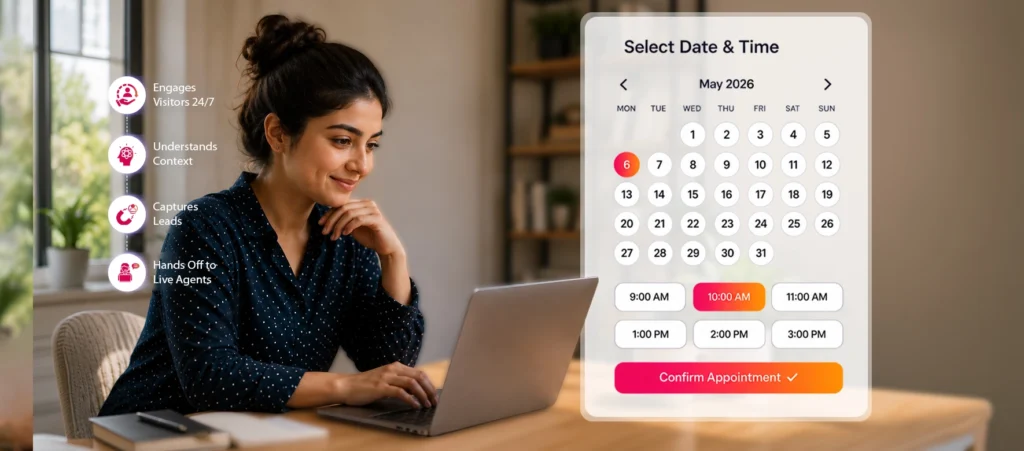
How Do AI Receptionists Work? And Can They Book Appointments Automatically?
In This Document
Switch to AI ChatIQ and see the difference.
An AI receptionist works by using Conversational AI to understand visitor questions, provide relevant answers, collect information and guide people towards the right next step. On a website, visitors can simply open the chat and ask what they need instead of searching through pages or waiting for someone to respond. Some systems can also connect the conversation with AI Appointment Booking workflows.
So, how do AI receptionists work in an everyday business setting? Think about someone arriving on a salon website after closing time and asking, “Do you have appointments available this Saturday?” Instead of filling out a form and waiting until morning, they can start a conversation immediately, ask follow-up questions and decide what they want to do next.
That is where Conversational AI becomes particularly useful. It gives visitors a way to interact with a business in much the same way they would through an online chat with a member of the team, while helping the business handle common questions and enquiries even when someone is not immediately available.
Imagine Maya is looking for a salon on a Tuesday evening.
She has already opened three different websites. One looks promising, but before she books anything, she wants to know whether they offer the service she needs and how the appointment works.
It is 9:45 PM.
The salon closed hours ago.
On one website, Maya finds a contact form.
“Leave your details and we’ll get back to you.”
She closes it.
On another, she spots a chat window and types:
“Do you offer this treatment?”
She gets an answer.
Then:
“How long does it take?”
Another answer.
Finally:
“Okay, how can I book?”
This is the moment that explains the appeal of an AI receptionist better than any complicated definition can.
The customer had questions before she was ready to take action. The business was unavailable, but the conversation did not have to stop.
Step-by-Step: What Happens When a Visitor Lands on Your Website
The technology behind an AI receptionist can be sophisticated, but the experience for the visitor should be remarkably simple.
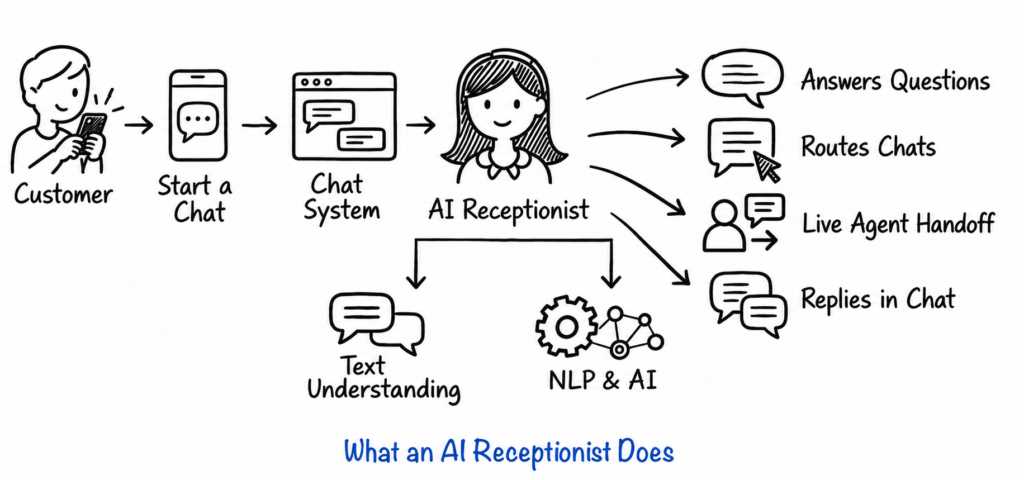
1. The visitor starts the conversation
Someone lands on your website and has a question.
Instead of navigating through several pages looking for an answer, they open the chat and type it.
A salon visitor might ask:
“Do you have appointments this weekend?”
A potential software buyer might ask:
“Does this integrate with my CRM?”
A prospective client might simply say:
“I’m not sure which service I need.”
They do not need to know where that information lives on your website. They only need to know what they want to ask.
2. Conversational AI interprets what they mean
Older website chat experiences often depended heavily on predefined buttons and scripted conversation trees.
Choose a topic.
Select an option.
Click another option.
Conversational AI allows the interaction to be more natural because visitors can ask questions in their own words.
The system interprets the request and determines what information is relevant to the conversation.
3. It uses information about the business
This is an important part of the process.
An AI receptionist should not be guessing your opening hours, inventing your services or creating policies that do not exist.
It needs access to reliable information supplied by the business.
For example, Bookzzy AI Chat IQ can use business information from website URLs, PDFs and custom content. This gives it a relevant knowledge source for answering visitor questions.
If your services, policies or other information change, the knowledge available to the AI needs to reflect those changes too.
4. The visitor can keep asking questions
This is where the experience starts becoming genuinely useful.
People rarely have exactly one question.
Maya might start by asking whether a treatment is available.
Once she knows it is, she may want to know how it works.
Then she may want to know how she can make an appointment.
The conversation develops according to what the visitor actually wants to know rather than forcing everyone through exactly the same website journey.
5. An interested visitor can become a lead
At some point, a casual question can turn into genuine buying intent.
That is when the conversation can begin collecting useful information.
Depending on the business, this could include:
- Name
- Email address
- Phone number
- Service or product of interest
- Reason for enquiring
- Relevant business requirements
For the business, this creates an important distinction between anonymous website traffic and someone who has actively expressed interest.
6. The conversation moves to the right next step
Not every conversation should end in exactly the same way.
One visitor may need more information.
Another may want to book an appointment.
Another might be ready for a sales conversation.
And someone else may simply want to speak to a person.
A useful AI receptionist should be able to support that transition rather than trapping every visitor inside an automated conversation.
With AI Chat IQ, conversations can be handed over to a live agent when human assistance is needed, allowing the conversation to continue with the existing context.
That is an important part of making AI useful in practice.
The goal is not to keep humans out of the conversation.
It is to bring them in when they are actually needed.
Try the best AI answering service free
AI ChatIQ answers questions and captures leads.Add your 24/7 answering service in minutes
Can AI Receptionists Actually Book Appointments?
Yes. AI receptionists can be part of an automated appointment-booking journey, provided they are connected to an appropriate booking or scheduling system.
There is an important distinction here.
Answering:
“Do you offer consultations?”
is a conversational task.
Actually reserving:
“Thursday at 3:30 PM”
is a scheduling task.
The second requires a booking system that can work with information such as dates, available time slots and calendar availability.
This is why AI Appointment Booking is better understood as a journey rather than a single AI feature.
The AI receptionist handles the conversation that happens before the appointment. It can help the visitor understand the service, answer common questions and identify what they want to do next.
The booking system handles the actual scheduling workflow.
Within Bookzzy, those roles are handled by different products.
AI Chat IQ handles conversational engagement, visitor questions, lead capture, qualification and human handoff.
BookingIQ handles appointment-booking workflows.
Together, the customer journey can look something like this:
Visitor arrives → asks a question → gets an answer → asks follow-up questions → shows interest → moves towards booking or human assistance.
That is much closer to how people actually behave online.
Customers do not always arrive ready to choose a date and time.
Sometimes they need a conversation first.
AI Receptionist vs. Human Receptionist: What's the Real Difference?
The natural question is whether an AI receptionist is supposed to replace the person sitting behind the front desk.
That is probably the wrong way to look at it.
AI and human receptionists are good at very different things.
| Situation | AI Receptionist | Human Receptionist |
|---|---|---|
| Answering frequently asked questions | Well suited | Well suited |
| Responding outside normal business hours | Can remain available | Depends on working hours |
| Handling several digital conversations at once | Can handle simultaneously | Limited by workload |
| Collecting basic enquiry information | Can automate the process | Can collect manually |
| Following a defined qualification flow | Consistent | Depends on training and workload |
| Handling unusual situations | Limited | Much stronger |
| Sensitive or emotional conversations | Human escalation may be appropriate | Better suited |
| Negotiation and judgement | Limited | Strong |
| Building long-term personal relationships | Limited | Strong |
| Repetitive website enquiries | Well suited | Can consume staff time |
The more practical model is not AI instead of people.
It is AI handling the repetitive first layer of a conversation so people have more time for the interactions where human judgement actually matters.
A receptionist probably does not need to personally answer “What time do you close?” fifty times every month.
They probably should handle the customer with a complicated request that does not fit neatly into an automated answer.
That balance is where an AI receptionist starts becoming genuinely useful.
Which Businesses Benefit Most?
AI receptionists make the most sense for businesses where customers frequently have questions before they are ready to enquire, buy or book.
Some obvious examples include:
- Salons and spas: Visitors can ask about services, treatments and the booking process before deciding whether to make an appointment.
- Clinics and dental practices: Patients often arrive with questions about available services and appointments. General administrative enquiries can be handled conversationally, while clinical or sensitive questions should remain with qualified professionals.
- Consultants: Prospects can explain what they are looking for before being directed towards the appropriate service or consultation.
- Agencies: Potential clients can ask about services, capabilities and suitability before submitting an enquiry.
- SaaS businesses: Prospects frequently have questions about features, use cases, integrations or demos before they are ready to speak with sales.
- Professional services: Accountants, property businesses, training companies and other service providers often receive the same initial questions from prospective customers.
The common thread is not the industry.
It is the behaviour of the customer.
If people regularly visit your website with questions before they take action, there is an opportunity for Conversational AI to make that journey easier.
What Should You Look for in an AI Receptionist?
The term “AI receptionist” is becoming increasingly broad, so businesses should look beyond the label and ask what the product actually does.
Does it know your business?
The quality of the conversation depends heavily on the information available to the AI.
Look at whether you can provide your own website content, FAQs, documents and other relevant information.
Can visitors speak naturally?
People should not need to learn how to talk to your software.
They should be able to ask a normal question and continue the conversation naturally.
Can it capture genuine enquiries?
Answering questions is useful.
Recognising when someone has moved from curiosity to genuine interest is even more valuable.
Look at whether the system can collect appropriate lead information during the conversation.
Can it connect with the rest of your workflow?
A lead sitting inside a chat transcript is not particularly useful if nobody sees it.
Consider how captured information reaches your sales or customer service process.
Can someone take over?
This is essential.
There will always be conversations that AI should not handle alone.
The system should provide a sensible route to human assistance rather than endlessly attempting to answer something it does not understand.
Where AI Chat IQ Fits In
This is the role AI Chat IQ by Bookzzy is designed to play.
AI Chat IQ adds a Conversational AI experience to a website so visitors can ask questions naturally rather than relying entirely on pages, forms and static FAQs.
Businesses can provide information through website URLs, PDFs and custom content, giving AI Chat IQ a relevant knowledge source for responding to visitors.
As conversations develop, it can help:
- Answer visitor questions
- Guide conversations
- Capture lead information
- Qualify enquiries
- Route lead information into configured workflows
- Hand conversations over to a live agent when human assistance is needed
Depending on the configured integrations, lead information and conversation details can also move into workflows involving CRM systems, Google Chat, email or webhooks.
The point is not to add another floating chat icon to a website simply because AI is fashionable.
It is to make that little chat window useful.
A visitor should be able to arrive with a question and leave knowing what to do next.
Back to Maya
Remember Maya from the beginning?
There are two ways her Tuesday-night search could have ended.
On the first website, she finds a contact form.
She thinks, “I’ll do this tomorrow.”
Maybe she does.
Maybe another salon gets her attention first.
On the second website, she asks her question while she is still interested.
She gets an answer.
That answer leads to another question.
Then another.
Eventually, she is ready to take the next step.
Nothing dramatic happened.
The business did not suddenly employ an overnight reception team.
It simply removed some of the waiting between “I’m interested” and “What do I do next?”
And that is perhaps the most useful way to think about AI receptionists.
Websites have always been good at displaying information.
Conversational AI gives them a better way to respond when somebody wants to talk about it.
Turn Website Visits Into Conversations With AI Chat IQ
A business can spend months improving SEO, running advertising campaigns, creating social content and refining landing pages to bring more people to its website.
But getting the visit is only half the job.
The visitor still needs a reason to take the next step.
Sometimes they are ready to book.
Sometimes they are ready to enquire.
And sometimes they simply have one question standing between browsing and becoming a genuine lead.
AI Chat IQ by Bookzzy gives those visitors a place to start the conversation.
It brings Conversational AI into the website experience so businesses can answer common questions, capture and qualify enquiries, connect lead information with existing workflows and bring a human into the conversation when needed.
Because the visitor who leaves your website is not always saying no.
Sometimes, they were simply waiting for an answer.
Explore AI Chat IQ by Bookzzy and turn more website visits into conversations worth continuing.
Questions? Answered.
Can't find what you're looking for? Our team typically responds within 2 hours on weekdays.
How do AI receptionists work?
+AI receptionists use artificial intelligence to interpret visitor questions and respond using information available about the business. Depending on the platform, they can also continue conversations, collect lead information, qualify enquiries, connect with other business workflows or transfer the conversation to a human.
Will AI replace receptionists?
+AI is better suited to repetitive and predictable conversations than situations requiring judgement, empathy or specialist knowledge. A more practical use is allowing AI to handle routine enquiries while human team members remain available for conversations that genuinely need them.
Can an AI receptionist book appointments automatically?
+Yes, when the AI receptionist is connected to an appropriate scheduling or booking workflow. The booking system needs access to information such as available dates and time slots before an appointment can actually be confirmed.
How does an AI receptionist handle calls?
+This depends on the product. Some AI receptionist platforms are built specifically for voice and phone calls, while others operate through website chat or messaging channels. Businesses should check which communication channels a particular product actually supports rather than assuming every AI receptionist handles phone calls.
Can AI receptionists integrate with a CRM?
+Some can. CRM integration allows information collected during a conversation to move into the business's existing lead or customer workflow. AI Chat IQ supports configurable lead-routing workflows that can include CRM systems, Google Chat, email and webhooks.
Are AI receptionists available 24/7?
+Digital AI receptionist software can remain available outside normal business hours, allowing website visitors to ask supported questions even when employees are offline.
What happens if an AI receptionist does not know the answer?
+There should be a route to human assistance rather than forcing the AI to continue answering. AI Chat IQ supports live-agent handoff when a conversation requires human involvement.
Is an AI receptionist only useful for appointment-based businesses?
+No. Appointment-led businesses such as salons and clinics are obvious use cases, but AI receptionists can also help consultants, agencies, SaaS companies and professional service businesses that receive questions or need to qualify website enquiries.
Can AI lead generation software integrate with a CRM?
+Many products offer CRM connectivity, but the scope differs between vendors. Buyers should check exactly which records, fields, conversations, activities, and qualification data are transferred, whether synchronization is one-way or two-way, how duplicates are handled, and what happens when a record already exists.
Is AI lead generation suitable for small businesses?
+It can be. Small businesses often have limited time for manual prospect research, qualification, and immediate website responses. The business case still depends on lead volume, website traffic, deal value, sales process, and software cost. Automating a task that occurs only a few times each month may provide little benefit.
How do you choose AI software for lead generation?
+Identify the acquisition bottleneck first. Determine whether the company needs prospect discovery, better website conversion, enrichment, qualification, prioritization, outreach, or faster routing. Then evaluate products based on that workflow, required integrations, data handling, human controls, implementation requirements, and measurable sales outcomes.
Will AI replace salespeople?
+AI is more likely to change how salespeople spend their time than remove the need for them entirely. Research, summarization, scoring, routine qualification, and administrative work can increasingly be automated. Relationship building, complex discovery, negotiation, commercial judgment, and strategic account management still rely heavily on human context and decision-making.